
Patient Preferences in Inflammatory Bowel Disease (IBD)
Understanding What Matters Most to People Living with IBD
Since 2020, the International Federation of Crohn's & Ulcerative Colitis Associations (IFCCA) has partnered with KU Leuven (Belgium) to better understand what people living with Inflammatory Bowel Disease (IBD) value most when choosing treatments.
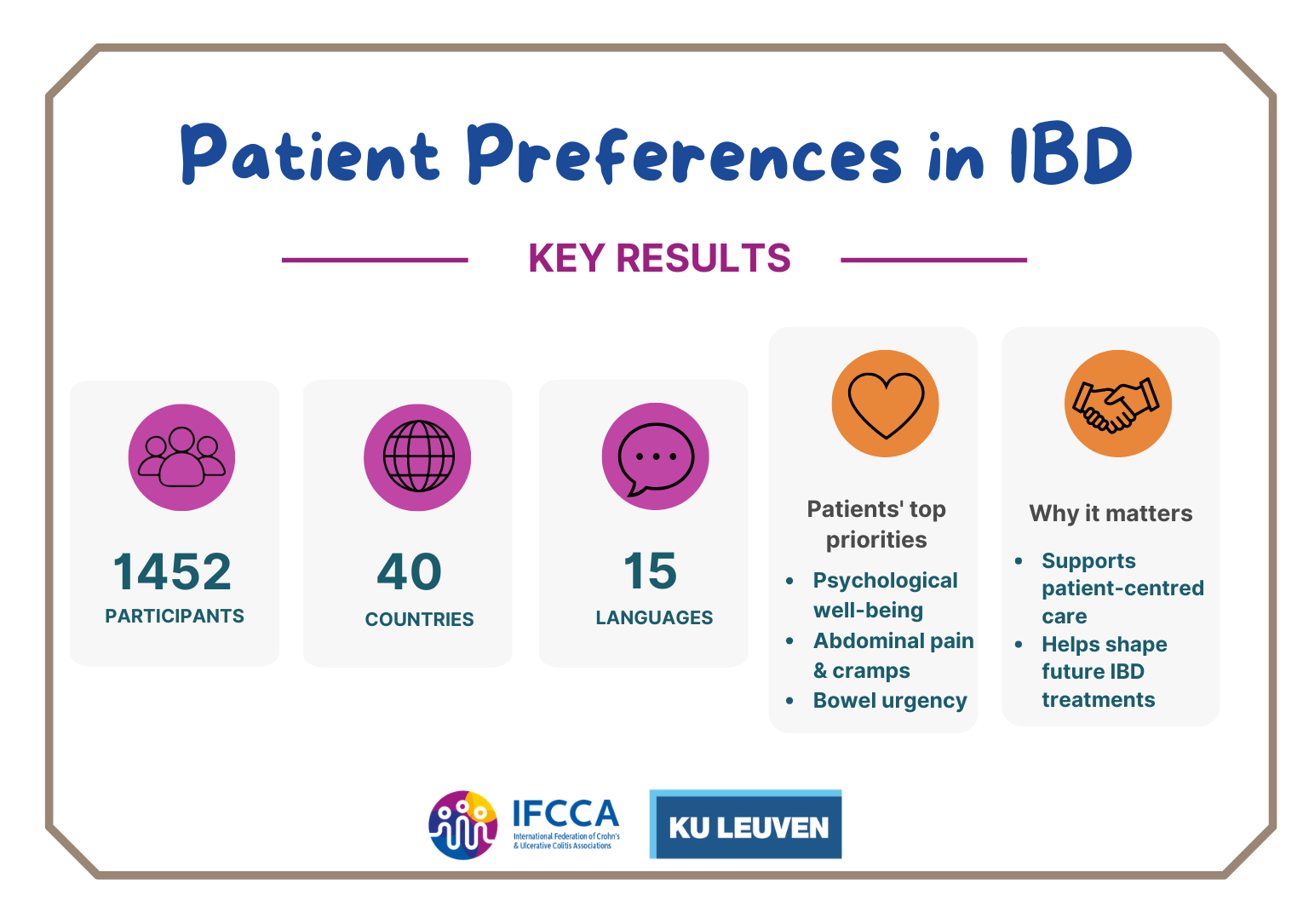
Through one of the largest global patient preference studies in IBD, 1452 people from 40 countries shared their experiences and treatment preferences. The survey was available in 15 languages, making it possible to capture perspectives from a diverse international IBD community.
The study provides valuable evidence to support more patient-centred research, treatment development and healthcare decision-making.

About the project
There has long been limited scientific evidence on patient preferences in the IBD community. To help address this gap, IFCCA launched this project in 2020 in collaboration with KU Leuven (Belgium).
Building on a national study previously conducted by KU Leuven on IBD patient preferences, and drawing on similar research in other disease areas, the project expanded this work to a global level. Through an international survey, IFCCA and KU Leuven set out to better understand what people living with IBD value most when choosing treatments.
Project Journey

The Questions Behind the Study
To better understand treatment preferences, the survey invited people living with IBD to reflect on questions such as:
What do you find most important in your IBD treatment?
Which aspects of your quality of life matter most?
Which side effects would you most like to avoid?
What characteristics should future IBD treatments have?
Why Patient Preferences Matter
Patient preference studies help us better understand:
What matters most to people living with IBD
How much different treatment characteristics matter
Which treatment features patients value most
What trade-offs patients are willing to make
Which risks patients are prepared to accept
How preferences differ according to individual characteristics and experiences
Understanding these preferences helps ensure that future research, treatment development and healthcare decision-making better reflect the priorities of people living with IBD.
Main objectives
The project aimed to:
Reveal the unmet needs of people living with IBD regarding current treatments.
Quantify the importance (“weight”) of relevant IBD treatment attributes
Evaluate the Monoclonal Antibody Resistance that IBD patients express for different treatment alternatives
Determine preference heterogeneity, i.e., to investigate how preferences are influenced by participants’ characteristics
Project Team
Researchers from KU Leuven and representatives from IFCCA
Publications & Resources
Patient Preferences for Inflammatory Bowel Disease Treatment: Results from a Global Survey Conducted in Partnership with the European Federation of Crohn’s & Ulcerative Colitis Associations (July 2026) (Springer Nature Link)